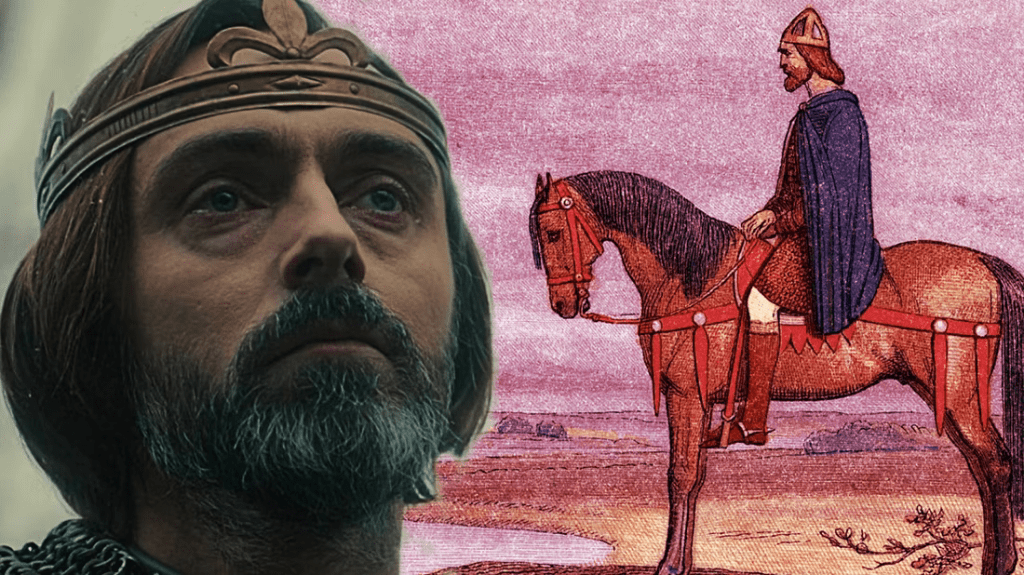
He is Alfred, the son of Athelwulf, the son of Egbert, the son of Ealhmund, the son of Eafa, the son of Eoppa, the son of Ingild, the son of Cenred, the son of Ceowold, the son of Cuthwulf, the son of Cuthwine, the son of Ceawlin, the son of Cynric, the son of Cerdic, the son of Elesa, the son of Esla, the son of Gewis, the son of Wig, the son of Freawine, the son of Frithugar, the son of Brand, the son of Bældæg, the son of Woden, the son of Frealaf, the son of Finn, the son of Godwulf, the son of Geat, the son of Tætwa, the son of Beaw, the son of Sceldwa, the son of Heremod, the son of Itermon, the son of Hathra, the son of Hwala, the son of Bedwig, the son of Sceaf, the son of Noah, the son of Lamech, the son of Methuselah, the son of Enoch, the son of Jared, the son of Mahalaleel, the son of Cainan, the son of Enos, the son of Seth, the son of Adam.
Alfred ruled for around 28 years.
In 853 AD, Alfred was sent by his father to Rome, to be consecrated as King by Pope Leo.
In 868 AD, Alfred went with his brother King Ethelred to Nottingham in Mercia, to support Burgred the King of Mercia, facing the Great Heathen Army led by the sons of Ragnar. No battle occured, the Mercians eventually made peace with their enemies.
In 871 AD, Alfred and his brother King Ethelred, fought against The Great Heathen Army at Reading, and then 4 days later at Ashdown. It was a bloody battle. Later, they battled at Basing, but the Danes won. After 2 months, another battle occured at Meretun. After Easter, King Ethelred died. A monther later, Alfred, now a King, fought with a small force against the army of the Danes at Wilton and the Danes won. Nine more battles occured during that year. Nine Danish Earls and one King were killed. Eventually, peace was made with the Danes during the same year.
In 875 AD, Alfred had a naval battle against 7 ships during the summer, he managed to capture one ship.
In 876 AD, Alfred made peace again with the Danes, who offered hostages in exchange, and swore oaths, however they used this to move a large army to Exeter, which is located to the west of Winchester.
In 877 AD, Alfred rode to fight them at Exeter, his enemies were expecting the support of a large fleet which did not survive a great storm, and 120 ships were destroyed. Eventually, they made peace again, and his enemies offered hostages and swore oaths. They eventually went to Mercia.
In 878 AD, Alfred escaped to Athelney after a stealthy attack by his enemies who took control over the West Saxons. During this time, Ivar and Ubba were present there, Ubba was killed alongside 840 of his men. At Easter, King Alfred made a stronghold at Athelney, they fought against their enemies with the support of a group of people from Somerset. Seven weeks after the Easter, Alfred met at Egbert’s Stone the remaining allies from Somerset and Wiltshire. After one night, they all proceeded to Iley, and then another night in Edington, and he defeated the army of the Danes. They swore oaths to never return to his kingdom, and to be baptised. Thirty days later, King Guthrum and 30 of his most important men, came to Aller and they were baptized.
In 882 AD, Alfred had a naval battle against four Danish ships, and managed to capture two ships.
In 883 AD, Alfred received some wood of the Cross of Christ from Pope Marinus.
In 885 AD, Alfred went to the rescue of the besiege city of Rochester, and drove the Danes away. Later, Alfred sent a naval force from Kent into East Anglia to confront 16 Danish ships, and they won, however, on their way back, they faced a large Danish fleet and they lost the battle. Pope Marinus also died this year.
In 886 AD, Alfred occupied London, and all English people in there submitted to him. Alfred handed London over to Athelred, the lord of the Mercians, who later married Alfred’s daughter Æthelflæd.
In 888 AD, Alfred’s sister, Æthelswith died.
In 889 AD, Alfred’s godson, the baptized King Guthrum, now Athelstan, died.
In 891 AD, Alfred received three scots who intended to go to Rome, their names are Dubslane, Machbethu and Maelinmum.
In 893 AD,
Sources
ASC: The Anglo-Saxon Chronicle – edited by Dorothy Whitelock with David C. Douglas and Susio L. Tucker.
B: The Ecclesiastical History of the English People – Oxford World’s Classics
 UMLANDO
Leave a comment